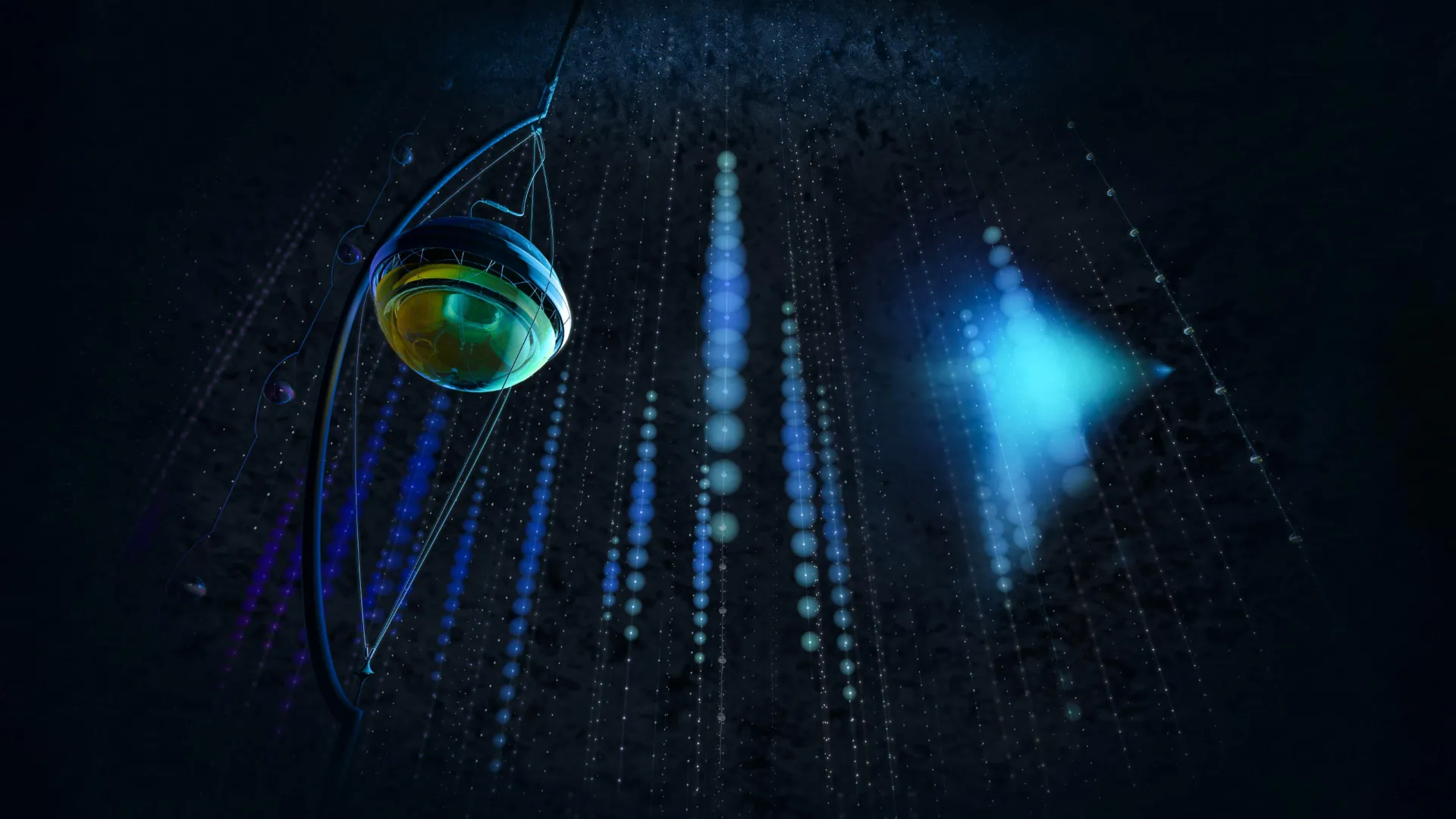
The IceCube Neutrino Observatory, buried in Antarctic ice, has detected neutrinos carrying energies roughly 10 billion times greater than those streaming from the Sun, according to Science Daily. The particles are extraordinarily rare: the detector records only a few dozen of the most energetic ones annually. The work behind the observatory and the discovery of high-energy neutrinos from astrophysical sources earned physicist Francis Halzen this year's Nobel Prize in Physics.
Why it matters
Neutrinos pass through nearly everything, including the Earth and the human body, without being slowed. That makes them almost impossible to catch, but it also makes them unusual messengers. They can escape regions around collapsing stars and black holes where other forms of radiation would be blocked, carrying information that cannot be gathered any other way. Science Daily reports that research on these particles has contributed to five Nobel Prizes in Physics.
George Fuller, a Distinguished Professor of Physics at the University of California San Diego who collaborated with Halzen on an early paper about IceCube, described the particles in blunt terms. "Neutrinos are truly ghost-like particles," he said. "It's hard to stop them. It's hard to catch them. How do we even know they exist or where they are?"
A particle that barely interacts
Neutrinos are elementary particles, meaning scientists believe nothing smaller makes them up. They come in three types — electron, muon and tau — and carry no electric charge. They do have mass, but it is tiny, possibly around 10 million times smaller than an electron's. Their exact masses and the process that gives rise to them remain unknown.
What sets them apart is how seldom they interact with anything. When they do, it is through the weak interaction, a force roughly 20 orders of magnitude weaker than electromagnetism. Fuller illustrated the point by saying that even light years of lead would not stop them, depending on their energy.
The numbers involved are hard to picture. About 100 billion neutrinos cross every square centimeter of a person's body each second, almost all of them unnoticed. Estimates put the universe's total at around 10 to the 89th power — roughly a billion for every atom that exists.
Wolfgang Pauli first proposed the particle in the 1930s to explain energy that seemed to vanish in certain radioactive decays. He understood the difficulty he had created, remarking that he had postulated a particle that could not be detected. It took until 1956, when Clyde Cowan and Frederick Reines detected neutrinos in an experiment called Project Poltergeist, for the idea to be confirmed.
Why the South Pole
Halzen saw in the 1990s that the South Pole offered an ideal setting. Deep beneath the surface, Antarctic ice is exceptionally clear, with few bubbles or impurities to interfere with faint light signals. His vision became IceCube, an instrument embedded in about a cubic kilometer of ice, built by drilling deep holes and lowering strings of light sensors called photomultiplier tubes.
The sensors look for brief blue flashes of Cherenkov radiation. These appear when a neutrino strikes matter in the ice and produces a charged particle moving faster than light travels through that medium. A muon produced this way, for example, generates a cone of light the detectors can record. By capturing such flashes, researchers can identify neutrinos that would otherwise leave no trace at all.
The observatory is built for the rarest arrivals: high-energy neutrinos from distant cosmic sources, quite unlike the vast, low-energy flow produced by the Sun. Science Daily notes that figuring out where these cosmic neutrinos originate remains an open problem, and that radio telescopes could help pin down their sources. Halzen's award citation recognized his decisive contributions to IceCube and to the discovery of high-energy neutrinos of astrophysical origin.
What to watch: as IceCube keeps logging these rare events, the push to trace them back to their cosmic sources is likely to intensify.